


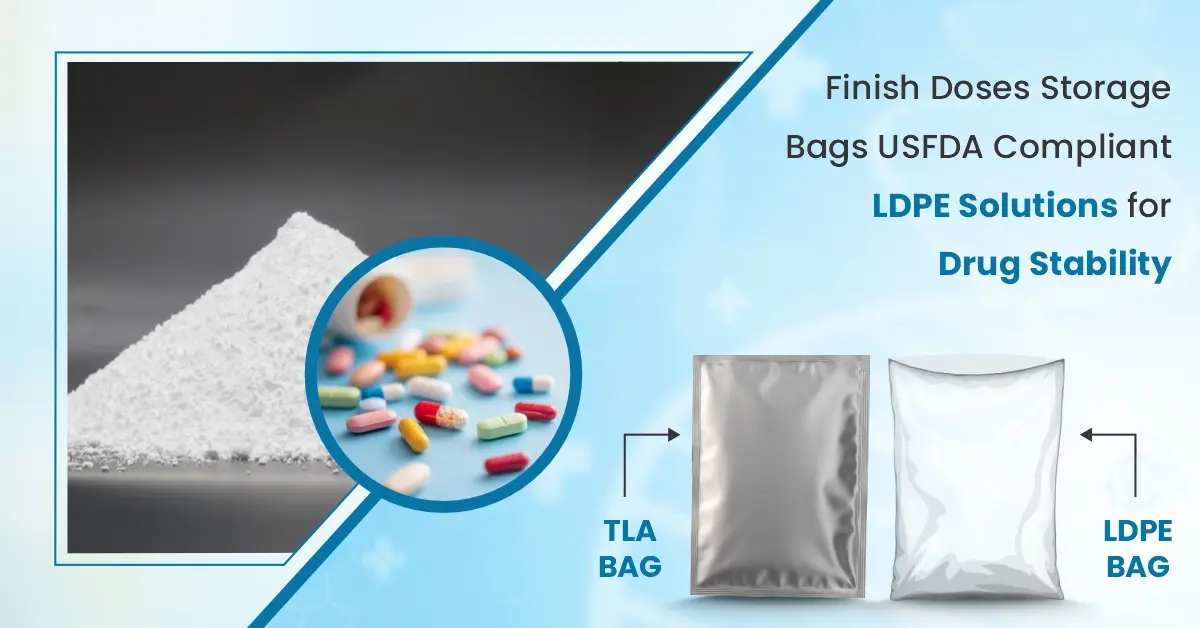
Pharmaceutical manufacturers understand something the broader packaging industry often overlooks what holds a drug matters nearly as much as the drug itself. Once a formulation clears every quality checkpoint, it enters the one phase where risk does not announce itself loudly: storage. And within storage, the choice of primary packaging determines whether a product reaches the patient in the condition it left the facility. Finish doses storage bags are not peripheral to this equation. They are central to it.
This page examines why USFDA-compliant LDPE bags have become the default standard for finished pharmaceutical products, how they address the core challenge of LDPE solutions drug stability, and what manufacturers must evaluate when specifying the right bag for each application.
The Stability Problem That Starts After Formulation
Drug degradation does not always happen at the formulation stage. A significant share of stability failures occur during secondary packaging, bulk holding, and distribution stages where the product is assumed to be safe but is, in fact, in prolonged contact with its packaging material.
Pharmaceutical LDPE packaging addresses this by creating a physical and chemical barrier between the drug substance and its environment. Low-density polyethylene, by molecular structure, delivers a combination of flexibility, chemical inertness, and moisture resistance that few other materials replicate at comparable cost. But not all LDPE performs equally. The difference between a compliant bag and a non-compliant one is rarely visible to the naked eye it surfaces in extraction studies, compatibility testing, and, in the worst cases, regulatory findings during an audit.
What USFDA Compliance Actually Requires?
Compliance with USFDA standards for pharmaceutical packaging is not a single certification. It is a framework of requirements covering material composition, manufacturing conditions, and documented traceability. For LDPE bags used in pharmaceutical storage, the anchor regulation is 21 CFR compliant LDPE specifically, 21 CFR 177.1520, which governs olefin polymers intended for contact with food and drug products.
Beyond material composition, the FDA expects packaging suppliers to demonstrate:
- Extractables and leachables profiles that pose no risk to drug product integrity
- Manufacturing conducted in controlled environments that actively prevent contamination
- Batch-level documentation structured to support pharmaceutical supplier qualification audits
When a finished dosage manufacturer selects a bag without verified 21 CFR compliant LDPE status, they inherit the compliance risk of their supplier and that risk does not stay with the supplier when an inspector arrives.
Medical Grade LDPE and What Sets It Apart
Medical grade LDPE bags differ from industrial alternatives across several critical dimensions. The resin used in medical-grade production is selected for purity, with strict controls on additives, plasticisers, and slip agents that might migrate into the drug substance over time. Processing is carried out in environments where particulate contamination is managed systematically, not incidentally.
For solid oral dosage forms tablets, capsules, granules the primary threat is moisture ingress. Humidity accelerates chemical degradation, promotes microbial activity, and physically alters tablet coatings. Moisture-proof finish doses bags constructed from medical-grade LDPE use a combination of wall thickness, seal integrity, and, where specified, multi-layer laminate construction to deliver water vapour transmission rate (WVTR) values that align with the drug product's stability specification.
For hygroscopic APIs and excipient blends, the packaging specification is not a default selection it is derived directly from accelerated stability data. Manufacturers working with API excipient LDPE solutions must match the bag's barrier performance to the humidity sensitivity profile of each specific material.
Antistatic Performance for Fine Powders and Sensitive APIs
When packaging fine powders, granules, or coated micro-pellets, static charge moves from a nuisance to a genuine operational concern. Antistatic pharma storage bags resolve two overlapping problems simultaneously: product yield loss caused by fine particle adhesion to inner bag surfaces, and process safety risk in environments where the API has a low minimum ignition energy in micronised form.
Antistatic performance in LDPE bags is achieved either through surface treatment or through the inclusion of conductive additives within the polymer matrix. The appropriate approach depends on the nature of drug-contact exposure and the migration potential of the chosen additive making independent compatibility testing a non-negotiable step before specification is locked in.
Cleanroom Manufacturing: Classification, Not Just Cleanliness
Cleanroom LDPE finish doses bags carry a verified environment classification typically ISO 7 or ISO 8 — backed by particle count monitoring, environmental sampling records, and personnel qualification documentation. Every bag exiting a cleanroom zone is sealed before it leaves the controlled area, preserving the microbiological status of the inner surface throughout the supply chain.
For pharmaceutical manufacturers operating under strict contamination control regimes, the manufacturing provenance of the bag matters as much as its physical specification. A supplier who provides cleanroom certificates, batch-specific environmental monitoring data, and full material traceability from resin lot to finished product enables a clean supplier qualification file no gaps, no follow-up queries.
EU GMP Alignment for Dual-Market Manufacturers
While the USFDA framework shapes much of the global pharmaceutical packaging conversation, manufacturers supplying European markets or running dual-market facilities must also demonstrate alignment with EU GMP LDPE bags requirements. The revised Annex 1 and broader EU GMP packaging provisions introduce expectations around material qualification, supplier auditing, and contamination prevention that closely parallel but do not identically replicate the FDA framework.
Bags specified for dual-market use require documentation that speaks to both regulatory systems simultaneously. This is achievable when the supplier has structured their quality management system to address both, and when material qualification studies have been designed with that dual-market requirement in scope from the outset.
Bulk Drug Stability Packaging: Scale Without Specification Compromise
At the bulk holding stage, volumes increased considerably but the specification must not loosen to accommodate them. Whether holding in-process blends ahead of final compression or storing finished tablets before packaging line allocation, bulk drug stability packaging in LDPE must maintain the same material and barrier performance regardless of bag volume.
Standard formats range from 10 litres through several hundred litres. Across that range, the heat seal is where performance most often fails. Seals on large-format LDPE bags must be validated at the specific combination of seal width, temperature, and dwell time that produces a hermetic joint across the full bag perimeter. Seal validation is tied to each format, each sealing equipment configuration, and each manufacturing site it is not transferable by assumption.
The Shelf Life Extension Case for Better Packaging
Pharma shelf life extension is most often pursued through reformulation or excipient adjustment. The contribution of packaging to shelf life is demonstrable but frequently underweighted in the development decision. When LDPE bags consistently deliver on their WVTR specification, maintain seal integrity through temperature cycling, and prevent light exposure where required, they extend the window within which a product remains within its approved specification.
The commercial implications are direct fewer expiry-driven write-offs, reduced buffer stock requirements, and greater distribution flexibility in temperature-variable markets. For manufacturers supplying across diverse geographies, packaging selection is one of the few stability levers available that does not require going back to the formulation.
Specifying the Right Bag: A Technical Decision, Not a Procurement One
The specification for a finish doses storage bag involves the formulation scientist, quality team, regulatory affairs function, and supply chain not just the purchasing department. Parameters that must be defined include resin grade and additive profile, wall thickness and validated WVTR performance, cleanroom classification of manufacture, seal configuration and integrity validation method, antistatic requirement based on API properties, and the regulatory compliance documentation required for each target market.
Once those parameters are in place, supplier selection becomes a structured evaluation rather than a price-per-unit comparison. The bag that performs reliably across the full shelf life of the product, across every market it reaches, and across the regulatory scrutiny it will face is the specification worth locking in regardless of where it sits on the initial quotation.
The standard for pharmaceutical packaging is defined by the drug it is there to protect. USFDA-compliant LDPE bags, when specified, manufactured, and documented with the same rigour applied to the product itself, consistently meet that standard.
